

In this Episode
- [03:08]James Eder recounts his heart condition diagnosis and the decision to write a book to document his experiences.
- [09:44]James talks about the emotional stages of dealing with his heart condition, including denial, acceptance, and gratitude.
- [19:04]James discusses the importance of creating space, accountability, and support in coaching sessions.
- [23:43]James shares various stories of serendipitous moments in his life, including meeting important people and finding opportunities.
- [37:16]James recounts the process of organizing his book launch in San Francisco and New York, highlighting the support he received.
- [49:44]James talks over the importance of defining personal success and not comparing oneself to others.
- [53:59]James emphasizes the importance of living with intention and being grateful for each day.
James, it’s so great to have you on the show.
It’s great to be here. Thanks for having me.
First of all, let’s talk a bit about your new book, The Collision Code. How did that book come about? There must be some sort of amazing story behind it, the synchronicities or serendipities that brought that book into fruition. What happened there?
Absolutely, I’ve been watching a number of your interviews and various people talking about the process of writing a book, and I’m going to say it’s not for the faint-hearted. I think some people have an idea, and then there’s the reality of making it happen. For me, I guess my book journey, it started kind of four years ago, now that I was in hospital and the doctors, I found out a while before that, eight years ago, I found out I’ve got a heart condition, but then four years ago, they said that my heart condition had deteriorated, and that might be time to go on the heart transplant list.
The real kind of confrontation of that led me to then making the decision, if something happens to me, then I really need to have this book written, because things were happening to me in my life that I experienced and I did that one that were very important to me and around, kind of the concept of serendipity and connection, but also the importance in sort of community and living with intention. I think so many times we spend our lives, days turn into weeks, turn into months, turn into years, and we just find ourselves where we find ourselves, and until either something happens to us or someone we know, maybe something bad happens, do we then make a change that’s important to us?
For me, it was various kinds of messages, one of which centered on serendipity and connection, demonstrating how we can foster serendipity and create more. Second theme around isolation and loneliness, we’re so digitally connected, but at the same time, many people feel disconnected, and then there’s male suicide as well. People in their 40s face high challenges in that space as well.
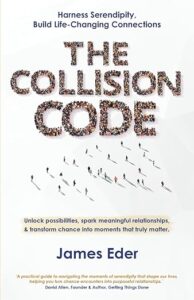
Then about the entrepreneurial journey that I’ve been on, and kind of the successes, not just entrepreneurially, but projects, ideas, things that I’ve had. I didn’t realize I was doing it. When I look back, there was a theme, and that’s where the code concept came from. I thought it was really important that if something happened to me, that this had been kind of documented and shared, so that’s kind of the essence and the story behind The Collision Code and where it started.
What transpired with you being on the heart transplant list, and it must have had some sort of breakthrough, so you could be here today talking to us on this podcast. What happened?
Absolutely. The thing for the audience to know, and partly raising awareness, is that I partly support the book as well, which was the heart condition called hypertrophic cardiomyopathy. It’s the thickening of the heart, and it’s most famous for marathon runners and footballers who can suddenly collapse and die fromit, and in the UK, one in 500 people have it. But a lot of people don’t know they have it. Obviously, those statistics will be represented across the world. The silver lining is that we know I got it.
Eight years ago, I fainted in a theme park. I hit my head. Went to the doctor, and they said, “Because you hit your head, come in and we’ll do a blood pressure test.” They did blood pressure, and they said, “Oh, it’s a bit different sitting down and standing. We recommend you go to the hospital to have an ECG, which is a basic heart monitor, a heart scan and some blood tests.” I just remember going to the hospital, and I parked my car in a pay-and-display bay, went in, thinking, “This is going to be a half-hour trip.”
They said to me, “If anyone died of a heart attack at a young age in your family? No?” and they went, “We just need to go and get the consultant.” I’m sitting there thinking, “My car’s on pay and display,” like, “I need to get on with my day,” kind of as we do in our lives, that we’re so busy and what we think is important. Anyway, they came back and said, “But you need an ultrasound,” which we did. Then they said, “You need to stay in the hospital.”
Again, the pay and display was like, “What can I do with my car?” They said, “I said, it’s about a five-minute drive.” They said, “Go park and then come back immediately and come to it; you need to be in the hospital.” That was three days in the hospital eight years ago, and they diagnosed me with the condition. Then over that summer, I had various tests, and they then referred me to a potential heart transplant assessment. They said to me, “You don’t need one now in my first assessment, but you need to come back in six months’ time.” It’s this kind of very challenging perspective, and I actually posted something about this on LinkedIn. Imagine you’ve been given a six-month slip. What do you do?
Experience is foundational, and practicing and gaining the confidence to build it will enable you to move on to the next step. Share on XI’ve not been given six months to live, per se, but I have also been told that in six months’ time, things might have deteriorated. It has the silver lining of giving me this kind of focus, of intention, of what it is that’s important. It’s making a lot of things they know easier. Because I’m like, “Does that fulfill me? Do I do? I really want to be doing those things.” When things deteriorated four years ago, I’d had an infection that was turning a corner and getting better, and I was on new medication. I said to the doctors, “I don’t want to go on the list now.” But it was borderline whether or not I needed it. They said it’s up to me ultimately, but they will tell me it’s that fine line of telling me and me also mentally being prepared, and there’s a certain number of statistics that you need to kind of get your head around.
One is the average life expectancy when you have a heart transplant, 11 years. The doctors are really playing this fine line of keeping me alive long enough on my current heart before it’s needed. Unfortunately, I’ve had a friend pass away who was on the list, and then it was too late, and it’s this really fine balance. At the time, I said, “No, I don’t want to go on it now.” But they reviewed me again every three months for the next year, and I’ve slowly gotten kind of better and stable on paper.
I’m still a heart transplant candidate, and I’m kind of living in this space of every six months now, seeing the doctors. I’ve got a defibrillator inside of me, so I’m bionic, which is quite amazing, which is made by Boston Scientific and every week, by my bed, there’s data that gets sent to the doctors. If there are any changes, trends, or things that they can see, then they’ll tell me about them. Fortunately, I have been more and more stable. As I say to the doctors and to people when I did the book launch, I’ve got the energy now, and 100% actually the royalties from the book are going to a number of charities, including the Heart Foundation and Cardiomyopathy UK, which is also really important. We’ve raised almost 10,000 pounds for various charities already. I’m saying to people, while I have the energy, use me. ‘How can I help? What can I do?’ That’s also given me a lot of purpose and intention, which has been, I feel, really grateful
How are you handling emotionally, being on this fine line between needing a heart transplant or potentially not, and the day-to-day of, I don’t know, just being at peace with it, being grateful for it, maybe even, I don’t know. I can’t imagine.
It’s a really interesting one. I think there’s a process that people talk about, which is the seven stages of grief you go through, and you find out something, and then there’s depression, and then you kind of, and then there’s acceptance, or denial and acceptance and various kinds of stages. I think when I first got diagnosed, I remember I was running a company, so that’s kind of my bit of potted background history. I started a company 20 years ago called Student Beans, which was all about student discounts. I left day to day 10 years ago with a view of running a business, and setting it up are two very different things. I’m much more of an innovation, the ideas guy and kind of that free-flowing stage.
I love what the business is doing, but I had another idea in me that was called Causa, which was a location-based LinkedIn, and you’ll see, I guess, the evolution of that is ultimately The Collision Code. The idea was to use technology to enable people to connect. You would log in with LinkedIn, and then you could see who’s nearby, kind of a dating app, but for business connections, and you could see who’s nearby, and you could see their status. It would be like traveling to New York for work.
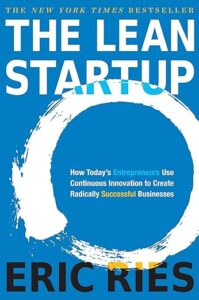
Does anyone want to go to the theater? Or you’ve got kind of the social business interaction there? We got over 3,000 users, and Richard Branson wrote about us; there was loads of press, and it was this really exciting kind of buzzy time. Then I fainted in the theme park in the middle of this business. It was a challenging story and growth, and what I was trying to do. I remember saying to all my investors, “Don’t worry, I’m fine. One in 500 people has got this, and it’s great we know about it. I can keep going.” That was the first bit, and I remember winning. There was Eric Ries, who founded The Lean Startup kind of book and concept and everything. I remember pitching at an event and winning.
I won a ticket to the Lean Startup conference. I just remember saying to my doctors, “I’ve won this, and I really want to go.” They’re like, “If you’ve got insurance, we’re not going to tell you can’t do something, but make sure you’ve got good insurance. Sure, you’ve got good insurance and good luck, kind of thing.” I remember the pushback, and I think my doctors said to me, “You’re very different from all our other patients, because I know you’re going to carry on, like living and doing the things that you want to do, and I think the silver lining is really this balance.”
The journey then, after being told about the transplant and the prospect of that, that’s when I said to my investors, “I can’t do this anymore. It’s that really weighed on me.” I remember going through therapy and speaking about the challenges of living in this way, of I can’t commit, I can’t do something I don’t want to. I can’t raise money for a company. Because what happens if, in three months’ time, they tell me, “Oh, you’re going to need a transplant?” I thought people, if I shared it, wouldn’t trust me.
There was a lot of like, my identity just completely fell apart. I remember then thinking, my therapist said to me, “Why don’t you?” I thought, for example, I was going to become a coach. The part of the story I’ve covered over the years, I did coaching 20 years ago as part of my dissertation at university, and someone contacted me saying they’d love a session, just kind of a mentoring session.
We did the session, and I was in a shopping center, and there was a pay-as-you-value head massage company, and I thought mentoring and coaching are interesting things. I’ve walked down the street thinking everyone knows what’s inside my head, but when you start having conversations with people and sharing knowledge and the experience I’ve had, I realized there was a lot that I could really make a difference and help people.
I kind of got to the place of, “I’m not in a position to set up my own company, because one, the stress and anxiety and building and doing and that pressure, but two, that kind of planning for the future.” Remember then, going back to this person and saying, “Look, I’m actually going to do this professionally. Would you be interested in doing? I’ll do it as a pay-as-you-value methodology, so you choose what you want to pay me, and then we’ll have a recurring session, so I’m not going to do a six-month program or a 12-month program, which is very common in the coaching world, because I kind of couldn’t.”
I think it’s a really interesting thing if you’re being challenged with something that you’re like, “Well, I can’t do that. I can’t sell a six-month package. Actually, how can you do it in your way? How can you make it work for you?” What I think is so funny about that engagement was that the first client ended up saying, “I’d like to work with you, and I’d like to do it weekly.” We ended up having, we’re still in engagement, which is almost again, eight years later, and it went from weekly to monthly, and it was over a 20,000-pound engagement. Now I would never have sold a 20,000-pound engagement. I would have never done the proposal. We’re going to work together for a number of years. Because it’s weekly, it unlocks, or because it’s an open-ended opportunity, then we get to explore things, and we recontract every so often.
“Is this still serving you? You’re still getting the value that you need and you want, what other support we’ve reached the end of what you originally signed up for is the what else would you like to explore, if you’d like to, all about kind of promote keeping it compartmentalized, to make sure we’re not just doing it for the sake of doing it.” Which is also super powerful. By having the restriction or being concerned, one is also about sharing with one’s eyes open. Part of my discovery call with clients is to say, “I’ve got a heart condition, and the reason why I’m coaching is I can’t do my own thing, but I want to help other people on their journeys.” Even in that sentence, there’s a freedom in that that I think I was so afraid of sharing originally. That gives you a bit of a glimpse. “How am I dealing with it now? Okay, I think day to day I’m stable.”
Again, four years ago, when I was bedridden, even my clients, I would get up, have a shower and do a client session. My original premise, and again, if people kind of, I often say when I’m speaking and sharing, “If there’s one thing that you’re going to get from this session, it’s about thinking in that moment, what is it that I can’t focus on, what you can do, not what you can’t do?” I remember saying to my clients and being open with them, “Look, I will be there for you and support you and do what I can, and if I can’t, obviously, what I will tell you.”
It’s really interesting when you’re being challenged with something.
But they served me during that time. My premise was that if I could get up and have one client a day, five days a week, then that would be a success for me. That was my starting point from being an entrepreneur and running businesses, doing 12 to 18-hour days. It sounds simple, but it was this. My aim was right over three months to have this revenue in less than three months. One client per day, and this means that I’ll go to bed at night having made a difference and contributed. Within three months of setting that intention, I hit my client target. Again, some of them I’ve still been kind of working with, kind of over a number of years.
There was a real event when I was bedridden; there was a purpose to get up. I had my shower, I got up, got dressed, sat on that call, did the Zoom thing, delivered the session, and then went back to bed. That was a number of weeks that were very challenging. But then also, you would use the word grateful and gratitude, and so grateful for the doctors, the support my clients, and it really just reframes like, ‘What’s a good day?’ For me, a good day is when I can breathe, be here, walk, and do the things I want to do. I guess the decision to go on the transplant list will be, if there are too many days in a row that I can’t do the things that I want to do, then that’s going to be the time. But look, I almost think the decision will be made for me.
Thank you for sharing. This is really powerful, what you’re sharing, because most people keep this sort of stuff close to their chest. They see it as a sign of weakness. They don’t want to share their successes, the Instagramable moments, or the reality of tough stuff. Do you have a lot of clients currently? How many at capacity are you? If our listener or viewer wants to work with you.
They’re more than welcome to reach out. I’m also very selective about who I work with. Is that capacity? Yes, but at the same time, it’s important that I do a discovery call. I do a free hour discovery call. What’s interesting again, people listening about whether it’s kind of coaches and doing a sales call. You kind of often, I used to do, you do this 20 minutes, and you set it up, and you get to know, but actually, by delivering more value and adding a whole hour and doing some real coaching within the session, gives people a lot of value, and then leads into kind of opportunities for both of us.
Very open, and I’m open on LinkedIn, if people, that’s my kind of default, if people want to connect with me, and it’s really interesting. Just related to that were two things I want to say. One is about vulnerability, which I’ll come back to, so many people talk about coaching, needing your niche, and who you focus on, and how you position yourselves. For me, what I did was I just again started, because people came to me, and it was all around kind of entrepreneurial. If you’ve got a business idea and you want to do something, where’d you start? But then, over the years, I kind of looked back at around 50 after I’d had about 50 clients, there were three themes that came up. One was called SAS. SAS, so it’s about creating space. The second one is about accountability, and the third one is about support. It was like those three things that, if I look back, that’s why we’re so day to day in what we’re doing.
My premise was that if I could get up and have one client a day, five days a week, then that would be a success for me. That was my starting point as an entrepreneur.
Again, this relates to living with intention. We’re so in the weeds of where that we can’t really see the perspective. By booking a coaching session, I always say it’s similar to booking a holiday. Once you book a holiday, it starts, you kind of, you’re already thinking about it. What should I buy? You kind of feel lighter because there’s that in, and similarly, I’ve got a coach that I work with, and it’s so interesting that even not in the session, you’ve like, “I’ve got that session next week. There are certain things I need to do by then, which set up the accountability.” She’s such a cheerleader for me. That’s where the support piece comes in, that I just want people to be happy and to succeed, and whatever success means to them, and also looking at defining what success is for you, not comparing to other people, which we so often do. Can I share the thing about vulnerability?
Yeah, please.
Well, because, again, I was really scared about sharing with people when I was first diagnosed. I remember I was invited to speak at the University of Birmingham at a conference, and I just shut down the company, and I just had this defibrillator put in, and the stitches were still almost wet. It was kind of wearing, kind of the bandages still. I thought it would be a good focus for me to go to the event, because it would be a bit of a distraction and being on stage again, and I remember the host of the event said to me, “Okay, you’ve closed down your business. What are you doing next?”
I hadn’t planned that answer, and I just kind of came out and said, “I just been diagnosed with this condition, and I just had a defibrillator put in, and you could hear the silence in the room.” It was kind of this gasping moment. I think that was a kind of shock, but it just encapsulated the room. Afterwards, this lovely girl came up to me, a girl called Grace, and said to me, “Thank you for sharing. My brother’s actually got a heart condition, and we’re twins, and he was born, he had viral meningitis, and then that caused complications with his heart. It wasn’t exactly the same condition, but you should talk to him. Reached out to him afterwards.”
We had a call, and he set up a charity called Save9Lives, which is the idea that if you’re on the donor list, you can save nine people. A lot of people don’t realize that different countries have different policies around opt-in and opt-out, but the value of this is. Anyway, so Save Nine Lives. Afterwards, he wrote me a card, a handwritten card, and he said, “Thank you so much for talking and for your support and what you’re doing and for saving nine lives and promoting. Here’s a pin badge.” I know it must be overwhelming with everything that you’re going through, but if you ever need an ear or you need help, please reach out. Unfortunately, Jim passed away when he was 23, and he had heart complications further. He was the person I referred to who was on the list, and then it was too late.

I’m sharing this story because when we’re going through something, for him to have, I’m going to say, the courage and the bravery and to offer me help, despite the challenges that he was facing, and I feel like he was a real inspiration and a role model. As I’m going through my journey as well, it’s ultimately, and I include the story about him in the book. It was that moment about vulnerability, being on stage, sharing that the more I’ve shared, the more things have opened up, the more opportunities have come to me, and I feel so grateful that if just again, one person hears it, or one person reads the book that makes a small change in their lives, that they make a decision that will help them move forward or move on, or do their do what they’re here to do, then that makes All the difference, and that’s why I feel like so empowered to be more vulnerable.
That’s wonderful when you’re sharing that story, and you’re saying how Grace came up and spoke to you after you’re sharing that, it made me think of the difference between serendipity and synchronicity, and how that chance occurrence wasn’t chance. I don’t believe serendipity is more like a happy accident, whereas synchronicity is more like the universe is lining things up for you, that there’s a divine orchestration happening, a rigged game, so to speak, in your favor, and you could have a happy accident, a beneficial kind of serendipitous event happen. But I don’t know. I just feel like the divine hand is behind everything that happens. I’m just curious what your take is on that.
I think the code relates to this: ultimately, as one thing the book says, by speaking on stage and putting yourself out there and being vulnerable, you enable the code to happen, because you’re giving people context to come and talk to you. If I go into a little bit of the code, so there are kind of the three elements of the code, and it’s interesting. I thought I’d share as well the idea behind the word ‘collision.’ I think for many people, it’s quite confronting. It’s kind of this hitting or one of force, and the negative perception of what a collision is. In the book, I set it up like this: when you’ve got a snooker ball or a billiards table, and you’ve got the white ball, and it hits another ball, it changes direction.
That’s the essence of The Collision Code: we’re in our lives, doing our own thing, and then suddenly we meet someone, and then something happens. Sometimes we don’t know, sometimes it might feel like it’s a bad thing, but actually, you look back, and it’s like, “Oh, had I again in that scenario not shared with this audience about what was going on, it wouldn’t have led to the conversation with Grace and her brother Jim.” In terms of the kind of synchronicity or the essence of it, there are three elements of the code. The first is permission. Often, we don’t feel we have permission to talk in certain environments. I know some cultures are better at it than others.
I feel so empowered to be more vulnerable.
I know on the London Underground it’s like, “No, no, no eye contact, don’t talk to anyone.” Perhaps in the US there is a more friendly, open, optimistic, but I see it in New York. I see it in San Francisco, people on their phones, in their world, not looking up, not connecting. It feels like it’s kind of jarring. Someone says hello to you, look at them and double-take sometimes, and you can see that happen. First is permission. What I say is, “It’s not about me giving you permission. It’s ultimately giving yourself permission, and who do you need that permission from?” But I say, “If you don’t feel like you’ve got permission, then blame me,” and say, “I heard a podcast, and it said that I should speak to someone random each day.” I’m standing, whatever it is, and use, I guess, the podcast or this version of a story as an excuse, as the permission to, I’m happy to take that blame.
That’s fine, if that feels like it gives you what you need to move forward. The first is permission, the second is confidence. Often, we’re not ready to do something until we’ve done it once. That’s where the essence of this kind of practice lies, in getting things going. There are examples in the book, but the final one is context; by speaking, you’re giving people context. Again, that synchronicity, I love that word. When you’re doing things, and you’re in flow, which I know is a great word associated with synchronicity, you’re in the right place at the right time, doing the right things.
It prompts me to think I was in a lunch conversation with Muhammad Yunus, who was the. He founded the Grameen Bank. He’s won a Nobel Peace Prize. I remember sitting next to him at lunch, going, “How do you decide what to do on a daily basis? How is it that I’m having lunch with you?” In my mind, I’m kind of thinking it was a whole setup. It was a conference called One Young World, bringing together people from over 100 countries, from around the world, in South Africa, and I found myself at this luncheon. Again, whether it be that you talk about synchronicity, you’ll see the dots where they join. I was involved in a student organization called ISIC 1948 after World War II, with a view to cultural understanding. If you’re going to go and live and work in another country, you’re not going to want to fight each other. I believe today, more than ever, around the world, that principle still supplies.
I then got selected to go to this conference in South Africa. I speak on stage. I get invited to this lunch. There are lots more intricacies in there, but at this lunch, I’m sitting on this table, and I remember in the room there was the CEO of Unilever, a guy called Paul Polman, Arianna Huffington was in the room, and that was there, like amazing world leaders. I thought, “You know what, I’m going to take a risk,” and I’m going to sit at the table where I don’t recognize anyone, because various people who were at the event weren’t in the room yet. I just thought I’d take this chance anyway. I sat down at this table, and then I realized I’m on Richard Branson’s entourage table with his kind of PR and social media person and this person and some other business people. I’m like, “I’m in the room, but I’m not in the room.” This is like, “What’s going on?”
A guy recognizes me from ISIC, from this conference when I was a student years and years earlier, a guy called Raj, and he was working for something called the B team, which is about an organization of people that are doing great things in the world, and business leaders and everything. He came and whispered to the guy next to me. The guy stands up and leaves, and then suddenly Muhammad Yunus is sitting next to me.
By speaking, you’re giving people context.
We then have this conversation, and his answer to me is, “How do I decide I’m doing the right thing?” I think we can get so caught up in the world and what we’re doing, and whether it’s right or wrong. Am I? How am I doing enough today? There’s a lot of pressure, I think that often comes from ourselves. Actually, that word, and kind of at the time, I thought, “Well, you’re a Nobel Prize winner. Of course, you can just say that. How can I take and embody that?”
But you look back, and maybe it’s those things we put so much pressure on ourselves. I think about exams and at school, and moments where things are going wrong, things happen, and then we look back, and they’re just to draw it, just you can disconnect from it once it’s time’s passed. But we put so much meaning into so many things. Actually, if we just took a bit of trust, and I love the phrase reframing, if you’re struggling with something, it’s like, “I get to do this.” I think there’s a lot around, “Oh, I’m stuck. I remember I was stuck in traffic this week, and I was driving, and it was meant to take three hours. It took four hours, and I was just driving on, thinking, “But I get to do this. I get to be here, and I’m late, and this is going to impact this, or this is what.” I think so often we just forget what a miracle it is to be here and live and contribute.
It is all a miracle. It was Albert Einstein who said that, I’m paraphrasing here, the view. Your viewpoint is either everything’s a miracle, or nothing’s a miracle. I choose everything as a miracle. Actually, I know with my deepest Inner Being that this is true, that everything is a miracle. I’ll share a bit of vulnerability here for myself, because when you’re talking about happening to sit at just the right table. One thing I do when I go to conferences is ask God to direct me to the correct table. I’ll leave it in his hands to tell me where to go. The most amazing synchronicities happen. It’s just incredible. Some people believe in psychic abilities, and some people don’t.
I’m very careful about what I say and who I share with and so forth, but these intuitive whispers, the still, small voice that you think is just you talking to yourself, that’s not you. You’re just an antenna. You’re an FM tuner, a radio picking up all sorts of different voices. They could be angels, they could be God, they could be the opponent. If you’re in a low vibration, you might be getting some really low-quality radio station coming in. That’s a good reason to up your vibration.
It just prompts me to think that there are a number of foundational stories kind of related in the book, that you can answer in that way, I guess. I guess what I’ve done, many models, is you’ve looked at something and then you’ve re, I guess, configured something to look back and be like, “Oh, that’s it.” But it again relates to what you’re saying. One of them was sitting on the ground, and a guy sat next to me with a resume, a CV in his hand. I just turned to him and said, “You’re looking for a job.” He ended up coming to work at my company. In that moment, you just think, “Okay, well, the context again, thinking about the code permission. I gave myself permission to say something.” I had the confidence because I was like, “I’m hiring this guy. He’s got a CB. He must be looking for a job.” The third one in that context, which really kind of aligns it. Then I said to a colleague, “I needed to speak to this specific company, at this specific brand.”
We're so day-to-day in what we do that we can't see the big picture. By booking a coaching session, you're already thinking about it—like booking a holiday. Share on X10 minutes later, I couldn’t hear something over the tannoy, so I turned to the guy standing next to me on the platform, and I said, “Is there a problem? Is the train coming?” Because I couldn’t hear what it said. He goes, “No, no train will be here soon.” I said, “Oh, you’re dressed up. Where are you off to?” He said, “An award ceremony about points and loyalty.” I said, “Oh, that’s interesting. I run Student Beans. What do you do?” He goes, “Oh, you don’t know of us, but we’re a company called Acorn, and we power these other outdoor adventure companies,” and he was exactly the brand, the exact person that I needed to talk to. It was like, 10 minutes later.
Again, that web synchronicity and something’s directing, but it’s, I guess, it’s looking for these moments. There’d be another person who would hear the tannoy, but just stand there thinking, “Oh, the train will be here soon or not.” I didn’t use it as an excuse again; I shared the story that it’s written. Now it’s part of the story, but in that moment when it happens, you’re just following it and just allowing it to happen. The final, I guess, related story that kind of brings this a lot together is my dad was on a train coming down from Newcastle, and the train stopped at Milton Keynes, which is about an hour from London. He literally thought, “What would James do?”
Again, if there’s one thing you’re going to take from this, it’s about thinking, okay, these stories, and why the importance of any story is about a lesson learned that you can then use to do something in your own life. He stood up and thought, “What would James do? Does anyone want to share a car back to London?” He stood up and shared with everyone kind of public announcement to the carriage. These two women said, Sure. After a bit of hesitation, they get in the car. They’re driving back. My dad says, “Where are you going?” They said, “We’re going into the suburb.” Nicholas Green said, “Whereabouts are you going?”
It turns out the house they were going to was the house that my dad used to own, and it’s the house that I lived in for the first five years of my life, and it was the grandest of the girls’ grandmothers’ houses. I just always think about that, around how many people on that train, how many carriages, all those things. Is it serendipity? I guess that, had he not said anything, you would never have known. But that was what was happening, and that was my vision for the app originally: ‘how can we create millions of meaningful connections for people nearby, all around the world, every day?’ There was this real intention of like, use technology to unlock those moments, those chance moments that you’re like, if I’ve got a bit of context that another world you would guess, open it and be like, “Does anyone want to share a car and broadcast it?”

People are facilitating that. It happens every day. Trains are canceled, flights are canceled. People need to do stuff. Again, the book talks a lot about these examples and these stories of bringing those to life. My vision would be that when people read it, it’s not about technology anymore. It’s actually about putting the technology down and having the confidence, the context and the permission to go and have these, create these moments that are serendipitous, synchronous, and all of these things.
Have you had any kind of visions or paranormal type experiences that are so far beyond just like a chance, seemingly chance coincidence, but something that’s like, “I can’t believe you couldn’t make this up, I can’t believe I just experienced that.”
Again, the one with my dad, and the fact that it was the home like that was when I share it, the thing is, I say, if you were going to write a fiction book about what I’m talking about, you would change some of the facts, because you would think they’re not real, just like if you think how many brands there are in the world, acorn, I didn’t know so. The story behind that is that there’s something called Virgin activity days, which was the brand that does the public brand, but behind it, it was powered by Acorn. I didn’t even know Acorn, or I just said, we need to speak to the company that delivers that for that brand.
Then 10 minutes later, meeting that, and I think you wouldn’t believe it if you saw one in a film. You’re like, “No, the writers of this film, they really need to do something, because this is unbelievable.” I know there are, I’m going to say, so many others, and whether it be in the book, again, these moments also prompt me. I applied for a load of jobs in New York in 2001, and I got rejected from all of them. I remember, at the time, being really disappointed. In it, there were jobs in the Twin Towers.
The more you share, the more opportunities you attract. Share on XThere were jobs within the square mile. I just remember I was 17 years old applying, applying, this is my dream, to go to the Big Apple. There was just something about it. I then found out about a work placement opportunity in San Francisco. At the time, I had no frame of reference for San Francisco or Silicon Valley, as it was just not on my radar. I remember then accepting that job and flying out to San Francisco in August 2001 and waking up on September 11th, thinking, “What happened at that moment, I applied for jobs there. I have got the applications, I’ve got the addresses, I’ve got like, this was not again in the moment, I was very frustrated about it, but then it was again.”
The one door opens, one door closes, another one opens and and I look back and it’s interesting, related to the book launch for The Collision Code is I share that story right at the beginning of the book, and a friend of mine in San Francisco was reading the book and said, “Oh, you should come to San Francisco and do the book launch.” It wasn’t even on my radar to do it. Then I contacted a friend to ask about coming to San Francisco. He’s like, “Actually, I’m going to be in Tokyo that week. Do you want to stay in my apartment?” I’m like, “Okay.” Then I contacted an entrepreneur first, who, well, I contacted my network out there to say, “Look, does anyone want to host the book launch?” The entrepreneur first said, ” We’ve got our offices in downtown San Francisco, and we’ll set it up. “If you want to host it there, that’d be great.”
Alice, who’s amazing. Do you know the entrepreneur first as well? Have you heard of an entrepreneur first? They literally bring people. They don’t even have an idea. It’s just people. They bring talented people together, and then they create businesses. The value of the businesses they’ve created since they started is over $15 billion, so when people say, “I don’t have an idea,” it’s about finding and harnessing the right people and connecting them together anyway.
Coming back to San Francisco, and this just came together. I’d had the London launch already. There was no plan to do the US tour. I contacted those people from my background. I was literally staying with my friend, who was in Tokyo; his apartment was on Folsom. The offices for Entrepreneur First were on Folsom. I then needed something printed. There was a print shop opposite. They literally printed it. I walked in, and they’re like, “We can do that. Instantly done.” It was just again, synchronicity, these things again. We raised over $1,000 for charity during the trip in San Francisco, and then I went to New York, and it was so in flow.
Because I’ve had to talk about death and confront it more, it’s given me a gift that has enabled me to live much more intentionally than everyone else, giving me more perspective.
There was just this moment of, you’re just doing the things and showing up and being intentional about it, and it’s an absolute highlight. I’m just so grateful for all of those people who kind of showed up. I had my roommate from 2001, who was there. People I worked with were there, and a whole load of new people. It’s interesting around unintended consequences, which includes this call and this podcast, because I reached out to invite you to attend an event in the US. You weren’t able to make it, but you said, “Hey, look, why do we do something? Let’s have a conversation about this.” Again, coming back down to trusting, and that’s what I’m really grateful for. Thank you.
Thank you for reaching out. Hundreds of times a day, I’m asking God what to do with decisions to make, and I try to walk in both worlds simultaneously. When I got your message, I got a lot of messages on LinkedIn, and yours, I was guided to respond and invite you to my podcast. I’m so glad we’re having this conversation. I’m curious, do you have a fear of death because you seem to be full of life and enthusiasm and desire to share and be of service and so forth? I forget where I heard it, but it’s impossible to be depressed if you’re focused on the needs of others.
I think there’s a contribution. Then there’s also gratitude. I think there’s also the brain can’t be depressed at the same time as being grateful, which is why gratitude journaling is just so powerful, because as soon as you flip and switch that, wow, powerful big question, am I afraid of death? I think the quote that comes to mind is, “Everyone dies, not everyone lives.” I feel like, again, silver lining, I’m spending time. I spend around half the year in the French Alps, which is just a dream. I know I spoke to my doctors, and I was like, “This is what I’d love to do, and can I?” Again, they supported me. The initial conversation was, “You’re going to wait one to two years for a transplant, and then, on average, you’re going to live 11 years with the transplant, and let’s say you’ve got around 14 years. Sure, do it like, why not go for it?”
I’m just so grateful for that. The silver lining, again, is the client and the work that I’m doing. Am I afraid of death? I think I’d be. Confronted with mortality at a much younger age than many people experience this, which I’m going to say is, like, it’s a gift, because it forces me. The forcing function is, do I get nervous every time I go to the doctors? I call it like the Twilight Zone, almost like a week before I’ve got the appointment, and things are just feeling more heightened. What happens if they tell me, now’s the time? Am I afraid of it? I think I’ve been so because of the process of the heart transplant; they kind of share with you, interestingly, and I’m sure there’s a reason why, before you’re told if you need a heart transplant or not, they talk you through the process fully.
If you go on the list, you need to be within four hours of the hospital. Once we get the phone call, you are blue-lit to the hospital, and you will receive the heart within four hours of basically finding out about it. There are certain things you can’t do. One of the things is you can’t have Mr. Whippy ice cream anymore, which makes me very concerned that if someone with a heart transplant isn’t gonna have Whittier with me, why are they still serving it to people in general? There are these nuances, but they took me through that process, so they kind of take you to the lowest point. It’s the drugs, the medication that you’re going to be on for life, the potential rejection of the heart, and very confronting, and then they tell me, “Oh, you don’t need one now. Come back in six months.”

It’s this really interesting dynamic, and I’m assuming they do it so that they’re getting you mentally prepared for when they tell you, now’s the time you’ve heard that multiple times, and you’ve got used to understanding, I guess, the process, what it really means. I think even with the defibrillator, when they told me I needed it, originally, I was quiet; I didn’t want it. Then I spoke to someone who had a defibrillator put in, and it saved his life three times. I was like, “Okay, I’m ready now, sign me up, give it to me and put it in.” Am I afraid of death? I think because I’ve had to talk about it and be confronted with it more, I think it’s given me a gift that has enabled me to live much more intentionally than everyone else, giving me more perspective.
This drive is interesting when you shift from worrying about yourself to actually contributing and helping other people that I know fulfills me up, and I think that’s my biggest thing is like wanting to make sure that I’m having the biggest difference, that I’m contributing the most while I’m here, and as long as I’m doing that, then that keeps me on the right side of life and what I’m doing.
What sort of nonprofits and charities are you aligned with these days? You said in the story about Grace that they saved nine lives, charity? Are there charitable organizations that you’re working with, or maybe you’re even thinking about founding one, like, “What? What are you up to in those regards?”
It’s interesting again. For those watching, there’s a great charity in itself called the Founders Pledge that brings charitable giving to the forefront of business giving. If you founded a company and you want to think more intentionally about contributing, basically, they’re a charity themselves. They’re funded not by the funds that you give, but by other people who donate to enable that to happen. I think I want to say there are billions of pounds that have been pledged, which is really interesting. That was kind of from my business hat on.
The foundational organizations that I’ve started to contribute to with the British Heart Foundation and Cardiomyopathy UK, which is my specific condition. But then the key things, I guess I’m so passionate about, really care about. One of them is The King’s Trust, which used to be called the Prince’s Trust in the UK, founded by King Charles when he was Prince of Wales. What was amazing was that they gave the student beans then, and the company a 3000-pound loan when we started 20 years ago. That was the only funding that the business got. From nothing, the business has grown to over 200 people, and the foundations of it were interesting. It’s not just about the money, but they gave a mentor, they gave support. I had to pitch to three, I guess, the equivalent of Dragon’s Den or Shark Tank.
I had to pitch. It’s like three, I guess, when I was 22, older people’s perception, beliefs, whether or not I was going to succeed or not, and the Prince’s Trust premise is that they should give money to young people if they will be better off with the money. They’re not making a judgment about whether the business is going to work or not. They’re making a judgment. If we give this young person that money, “Will they be able to learn something? Will we be able to grow? Will it enable them to get to their next stage in life, whatever that may be?”
If the business fails, they don’t want to be in a worse position. Suppose you give them the money, which, in some scenarios, if you just give someone a few 1000 pounds, it could create their world. It could make a challenge for them that perhaps they weren’t prepared for. But going back. That’s one that I’m supporting. The other one is ISIC, which I mentioned as the international student-run organization that I was involved in, and I went on placement to Colombia and to the Philippines, and I’ve actually set up. It’s not a an independent fund, but it sits within ISIC, UK, and again, related, unfortunately, a friend of mine passed away in a car accident called Andrea Eliott, and we with a couple of other alumni, set up The Eliott International Opportunity Fund, and the idea is that young people get to go and live and work again in another place. They’re going to get value. They’re going to grow into leaders.
I don’t want to swear, but using the term leadership, which, instead of leadership, because unfortunately, as we know, I think there could be a big improvement in leaders in the world. I believe ISIC is one of those organizations that help young people grow and develop leadership skills, compassion, and values-based leadership that I think is missing for many, many people in the world. There’s that and Young Enterprise, which is a program in the UK that helps young people set up a business. Again, when I was 17, that was my first experience of setting up a business.
It was a directory service, and we signed up over 200 businesses to that. That was my story, one of the stories in the book about being young and having the experience to be able to knock on doors and speak to people. I just remember there was one shop I went into. She’s like, “Get out whatever you’re selling. Get out of my shop. “ I remember thinking, what do all businesses want to do?” They want to make money. I was there selling for 10 pounds, this listing on a website. The money was profits. We’re going to go to the charity anyway. I slowly explained this and listened. We’re just from the local school, and this is what we’re doing. Eventually, after 10 minutes, we left with 10 pounds from her and a listing on the website. I just think again, kind of a simple message, “What’s the worst thing that can happen, and what’s the best thing that can happen?”
Because often we tell ourselves the worst thing, and in that moment, she screamed at me, “That’s the worst thing that can happen.” But the best thing is that experience was so foundational, and being able to practice and gain the confidence to get those experiences enabled me to then go on to the next thing and now build a business that employs over 200 people. I think without those foundations and the tagline for young enterprises, learning by doing. I just think it’s just so important that young people, again, put away technology, be out, have those experiences, and be able to practice and do something.
I’m kind of very keen on things that get people out, and again, community, education and enterprise. You can see there’s a kind of theme to that. That’s what the profits from the royalties from the book are, then being split among all of those organizations that I’ve just mentioned. I’m just so excited about being able to support them more and seeing the impact of all of those different initiatives.
You have to get out of your comfort zone. All growth happens outside of your comfort zone. If you have a dream, then make it bigger and actually start taking some action, and try to get comfortable being uncomfortable.
Have you had to use that phrase? Is this one thing you’ve got, is it post-traumatic stress? You’ve got the PTSD. But then the other phrase, which may tell me if you’ve heard of it, but post-traumatic growth, I think, is when things happen. I think about my heart condition, I think about the failure of my second business when that had to shut down, and the experience and the growth that I got from that, I believe, makes me a much better coach, because I’ve got a real understanding of a success, but also of a failure, and how to navigate that, and how to decide when to close something down when you’re so close to it, which, again, is a big challenge for many entrepreneurs that are struggling and fighting and pushing for something, and even though it’s a great idea, and there are so many things that make sense, if it’s not working, that’s also kind of a big challenge. They can take one thing, which is the post-traumatic growth. What did you learn from this? How can that help you, and trust that that’s meant to be part of your journey?
Even take it a step further, and maybe you actually made the decision before you came down here to have that challenge, to have that growth opportunity. What if you were on your life path as you were deciding with God, your angels, your guides, whatever, before you incarnate, “Okay, I’m gonna have a heart condition. I’m gonna have to close down my business. I’m going to need to do work that is pretty easy on my heart. I’m going to write a book.” I’m going to like all these things, the major things that you decided. Before incarnating, all came to pass, but you forgot that you had agreed to them. What if that’s true?
That’s quite a wild concept. Again, it’s coming back down to this trust of like I know I’m just so grateful the balance that I’ve got in my life today compared to when I was running a startup and being able to share and invest and contribute and help young people and doing what I’m doing, I’ve got to trust that that’s what I meant to be doing, and that’s why I mean.
You’re contributing to a lot of people through the book and through all the things that you do; it’s a ripple effect that we don’t really fully grasp, the full extent of, until after we pass, until we’re shown in our life review. As you said, “All these serendipities, synchronicities, it’s just lining things up for you, if you’re willing to just take a little action and be a participant in this game.” I remember one time, I’m an introvert, and I really have trouble at networking events where nobody knows who I am. I mean, I’m less so these days, but it’s still not easy going up to people who I don’t know if I’m a speaker, then people come up to me, but if I’m not a speaker, they don’t know who I am, so I don’t want to seem like I’m trying to sell them on something.
But this is decades ago, at an event, and I hadn’t had my spiritual awakening at that point, so I was still agnostic. I didn’t really believe much, but I met two guys who worked at the same company, and I couldn’t believe it, because the odds of it were probably one in trillions. I got them to give me their business cards, each of them, because it was so outrageous. One’s name was Stephan, and another’s name was Spencer.
Okay, wow. In the same company world, it’s just again. You can’t make it up. How did this happen?
It’s fun, but remember, it’s a game that’s rigged in your favor, so you might as well play full out. That’s love him or hate him. Elon Musk is playing full out because he sincerely, fully believes this is a video game. This is a simulation. Why not? What’s the downside?
The analogy of the game is when you’re playing tennis, and you’re playing the game, and things slow down when you’re watching it in the stands. It’s going so fast, back and forth, back and forth, and you can’t, how could they even hit it? But when you then get on the court, and you’re playing, and I just love that analogy of thinking, “If this is a game, then when you participate, and you’re active in it,” and again, that comes back down to living with intention that I’ve not mentioned.
Actually, I published a video series called Heart Matters – Living with Intention, and it really just documents the journey of my heart health, partly for anyone who’s got a heart condition or is going through a similar journey, making these decisions about treatment, about the defibrillator, about even pills. Went from not taking any medication to having to take four different medications every day, and adjusting to that and very similar things, having a pill box, which is just once a week.
I know you can get them for a month, but a month feels a bit overwhelming. Just once a week, then to sit, pop out all the pills, put them in my daily thing, and it just changed my relationship to instead of every day having to pop four different pills from four different packets. It might sound like a really simple thing, but for me, that really made such a big difference to kind of adjust to living that new life. I put together the Heart Health Series. It’s about 40 videos now, it’s again jameseder.com.
It’s where everything is, but it has a link there, and it’s why living with intention. I said it earlier. Often, we’re just days, 10 months, turning to years, and we just don’t live with intention we just find ourselves where we find and actually, when we start realizing again, if it is a game, and that freedom that it gives us, and the permission, I’m going to say to be like, “Okay, let’s challenge ourselves and put ourselves out and, like, see what happens.” I never, and I talk about this in the book as well. There are moments where I’m like, “Oh, I’m tired. I don’t really want to talk to anyone anymore, and I’m just gonna, like, stay at home tonight.”
There was one bit in the book, actually, it was in Mykonos, where I was like, “Oh,” and at the end of this three-week travel, I thought, “What, I’ll just go out.” I went into this bar, and there was a lady standing there, wearing a dress with hearts all over it. Obviously, I was drawn to this. She just looked fabulous and radiated energy. I shared with her that we just started talking, “I love your dress.” The context of conversation is why wearing anything like a badge or a football shirt creates context to start a conversation.
It’s about looking for them. It’s two things. One is about looking for them, but one is also about presenting yourself in that way, to enable people to be more approachable to them. I always say, person A, sitting there looking down in their own head on their devices, wearing a neutral covid versus person B, looking up smilingin a football shirt, obviously they’re going to a game or something, and enabling them to create those conversations. Anyway, back to Mick, and I was like a Daddy for talking to her.
It turned out that she had breast cancer and that she was recovering and going through this process, and just the vulnerability of sharing in this moment, we ended up having just a really special evening, moment and connection. It was like half an hour earlier. I mean, just thinking, I just don’t want to go out, and I’m just going to be by myself and do my own thing. I guess it’s even more so again, you need to balance and take rest. But in those moments when you doubt, you’re like, “Oh, should I say something?” That’s the time when you’re like, “Yes.” That’s important.
Awesome. Well, you’re an inspiration. Thank you, James, again. Your website is jameseder.com and thecollisioncode.com, and, of course, your book is available everywhere, including Amazon. Thank you so much for your vulnerability, your inspiring stories and just your positivity or outlook on life.
Thank you so much. It’s been great, and feel free to reach out if I can help you, or obviously, your listeners and viewers with anything. I’d love to hear from you. Thank you.
If our listener or viewer wants to hire you for coaching?
Absolutely, feel free to reach out.
Thank you so much. We’ll catch you on the next episode. I’m your host, Stephan Spencer, signing off.
Important Links
Connect with James Eder
Books
Businesses/Organizations
Films
People
YouTube Videos