

In this Episode
- [04:57]Matt Church explains his view on intuition, separating it into sense-making and pattern recognition, and referencing cognitive science.
- [12:52]Matt emphasizes the importance of being open to other possibilities beyond the scientific method.
- [27:44]Matt differentiates between skepticism and cynicism, noting that cynics often use skepticism as a mask.
- [31:42]Matt references Tyson Juncker Porter’s work on indigenous knowledge and its relevance to modern understanding.
- [44:17]Matt shares his own experience with executive function disorder and how it has shaped his approach to thought leadership.
- [52:12]Matt introduces the pink sheet process, a tool for capturing and organizing intellectual property.
- [57:34]Matt elucidates how the pink sheet process can be used to plan and deliver full-spectrum thought leadership experiences.
Matt, it’s so great to have you on the show.
Thank you, Stephan. That’s amazing. I’m based in Sydney, Australia. Hello to everybody. Wherever you are in the world and whenever you’re listening to this, I hope all your loved ones are well, that you’re healthy, and that your world has some traction to it. It’s getting some wheels and some motion, I hope.
There’s something in your bio that really spoke to me. I got to bring that out just before we dive into Pink Sheets and all the different cool modalities, systems, and things that you’ve developed over the years. Highly intuitive. What does that mean for you? How are you accessing intuition?
My profile you just read was written by Jenny, who was my editor-in-chief for my most recent book called Rise Up, which is a book called “An Evolution in Leadership.” Jenny knows a lot about my ontological and metaphysical bent. As a result, she wanted to weave some of that in.
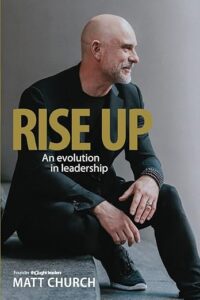
It’s always funny, you were talking to me about Knowledge Panels just before we got started and talking about expertise. I’m very aware that we all exist like diamonds, and there are facets or windows into us, your LinkedIn profile, your Facebook profile, whatever it might be, or your website, or as you were talking about the knowledge panel on Google. The back of the book is a version of that, the copy that talks about what the book’s about and what you’re about. I think that’s what she’s referencing here.
Now, your question on intuition. I find that the left-brain-right-brain distinction is useful until it’s not. George Box, the statistician, famously said that all models are flawed and some are useful. What we’re seeing with the corpus callosum, the left and right hemispheres of the brain, and cognitive science is that we’re seeing almost a collapsing of the distinction, which is not something that bothers me.
I am very happy that, in pretty much all learning, the compassionate approach is to break things into understandable chunks and then, at some point, integrate them on the journey to mastery. I think this whole idea of separation and integration is a natural flow with how we develop and embody knowledge.
That said, when I talk about intuition, I can separate it into sense-making and pattern recognition, both of which are highly analytical processes. You may not always be conscious of your knowledge, and probably worth invoking John Vervaeke, the cognitive science professor at Toronto University, and some of his work on the four Ps, the four ways we know—perspectival knowing, participatory knowing, and other things like that. It’s something for your listeners to check in with.
Open yourself to the possibility that knowledge can emerge from sources beyond the prevailing scientific method view. Share on XI was an atheist for 25 years, and now I don’t identify as such. The process of intuition can take, as I said, an ontological or metaphysical bent. Whether it’s pattern recognition, I don’t care. Whether it’s deeply connected to universal consciousness, I don’t care.
What I am aware of, through the Vedic traditions of non-duality, is that there is this moment where we go from a transparent view of the world, where our consciousness thinks it is the world, through to an opaque view of the world, where we step back, and we realize we are not the objects of our life. We are the subject or witness of the objects, and then we take one more step back, where we realize we’re the ground of being that looks through all of those.
Intuition, when described from the objective view, or the subject-object witness view, or the ground of being view, is a different answer to that question. I think you got that. I don’t think any of my answers are short, but I will try and keep them brief.
I find that fascinating because I did not understand what intuition was until just recently this year. Last year, I was given advice by a psychic medium who saved one of my family members’ lives during my podcast interview with him, which is an interesting story. What are the odds? During a three-week stint without a podcast while I was getting ready to move to Florida, I would interview him and him alone. That would be at the moment when a family member was having a stroke. She wouldn’t have gotten to the hospital if it weren’t for him. It’s incredible. He told me in reading that I’d never done readings before. I was not inclined to that. I used to be agnostic myself.
You’re a biochemist by training.
Yes, that’s true.
That doesn’t make any sense at all.
It’s pretty fascinating. I ended up getting a reading from him. This reading was really profound. One of the things that he shared at the end was, “By the way, listen to your intuition and follow it. This is very important.” I took that to heart, and I didn’t know where that would lead me. After the events that have happened this year with me—which is another story for another podcast episode—it’s been incredible. I am tuned in to intuition constantly, and it’s not me. I’m not coming up with this stuff. I’m just tuned in to the universal consciousness, my angels, whatever you want to call it. It is profound.

What I love is two guys who are heavily grounded in the sciences, having this conversation in the year 2021. For those who are on YouTube, if they check out Stephan’s shirt, it represents the integration of the synergy that you’re referencing, which is the interconnectedness of everything, and then also the geometry. I think this is going to be useful when we get to talking about Pink Sheet structures. We’re on a content marketing podcast. People go, what are these dudes talking about?
Essentially, what we’re exploring is where knowledge comes from? By the end of this podcast, we’ll have had a conversation about where your thought leadership could originate from. It might just be enough to give people a scaffold of three, and that we’re talking about the third. The first scaffold is that knowledge is exploratory.
These all start with this convenience. Like an archaeologist with a little dusting broom, you’re searching for insight by excavating knowledge. I’d suggest that the scientific reductionist, mechanistic view that’s been prevalent for the last 400-odd years is really good at that. It’s given us a lot of rigor and scientific methods for excavating knowledge. I love that.
Knowledge is exploratory.
I think that knowledge is also experiential. Our lived experience gives us a sense of knowledge, but that’s not one-dimensional. For example, it can be experienced based on what you’ve done. It can be an experience like the one on your resume. Knowledge can be unearthed by what you know. It’s what you’ve learned along the way, discrete subject matter expertise. It’s also the essence of who you are. You can experience it through at least those three timelines.
Knowledge is exploratory. Whenever I’m working with thought leaders, I go, ”Okay, so what have you done?” We put a resume on a timeline with all these critical moments, and we go, “What have you learned?” Then, with what you learned, we document that, and then we do, who are you? When you get essence, expertise, and experience, and bring them together, that’s the experiential knowledge source.
The third one that we’re talking about is emergent, and emergent knowledge is less evidentiary. It’s more like a revelation; it’s a revealed tree. When you look at the need for evidence and informed decision-making, which many thought leaders think they need and many content marketers build their world on, they go through the role of content marketers: survey your market and then publish your report. For me, that’s not thought leadership, that’s not insight development, that’s just simply gathering data and then feeding it back to people.
Make no mistake, pattern recognition from the analysis and interpretive meaning of big data is great, but it’s primary or rudimentary at best. It’s like what you do under the age of seven. And it doesn’t link to wisdom. This third one, this one that we’re talking about, that intuition taps into this idea of emergent knowledge, raises all kinds of questions that are ontologically challenging. There are the classic philosophical questions: “Who am I?” “Where do I come from?” “Do I even matter?” “When I go, where do I go?”
Philosophers of all kinds have had conversations about this for centuries. I’m a bit indifferent to it. I’m really happy to sit with whoever wants to talk. If someone wants to do the Socratic method or Neoplatonic concepts, I’m happy to listen. It’s a bit like sport. I’m the best friend to watch sports with, because I’m like a goldfish. I forgot the rules of the sport.
Emergent knowledge is less evidentiary. Every time I sit down, I’m your new friend that’s got to learn how cricket is or how American football is or something like that. I’m a really good audience member to watch the sport, but I really don’t care. I care about the moment deeply. If someone said, “Are you interested in what I’m talking about?” I said, “I’m really interested in anything you’re really interested in.” What I’m not interested in are the things that are just flippantly put up in conversation.
For me, intuition is really getting into the idea of emergent knowledge, and people get uncomfortable with it. What I want to suggest is that almost every line of scientific inquiry began with some form of intuitive wonder, some open curiosity, whether it’s sitting in a bath and watching it leak over, or an apple falling from a tree—whichever perspective it comes from; we’re looking at the moon and the sun—determining whether we’re heliocentric or not, if someone just goes, I wonder, and they open themselves up to curiosity and wonder.
Emergent knowledge is less evidentiary.
For me, that’s enough for intuition. Just to say, don’t be too premeditated, don’t be too preordained, and don’t be too evidence-informed. I don’t mean that we’re not evidence-informed; I just mean open yourself up to the possibility that knowledge can emerge from sources beyond the prevailing scientific method view. We’re both scientists, so we love hypotheses. We love experimentation. We both love the idea of being cautious with propositional knowing, where someone goes, this is true, we go, well, maybe it’s not. And that healthy skeptic nature is powerful.
What I think a lot of people do is they then become cynics. Their skepticism goes from, I wonder if that’s true, useful, or relevant. They actually start going, I wonder how I can shoot that down. If we look at First Nations, people around the world—I’m grounded here in Australia—the indigenous of Australia are the Eora nation. The Eora nation encompassed 500 nations. If you look at the map of Australia as the Eora nation, you’ll see 500 different nations. I’m in the land of the Gadigal, which is Sydney Harbour, so all the water that sits around Sydney with the Opera House, the bridge, and the things you see in your New Year’s Eve montages around the world with fireworks.
That indigenous knowledge is 70,000 years old. The primitive assumption is that before colonization, there was savagery and barbarity, and that just can’t be true. It just can’t be true that, for 70,000 years up until the last 250,000 years, there’s actually deep knowledge of complex adaptive systems and chaos theory embedded in the stories and dreamtime stories of our indigenous peoples. I think that there is a huge amount of intuitive knowing.
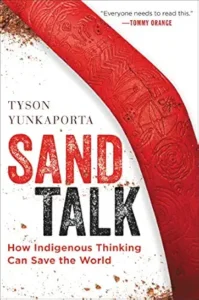
Tyson Yunkaporta—if you wanted to learn more about Australian indigenous knowledge—wrote a book called Sand Talk. I’m just holding that up for those who are on the audio podcast. He’s the head of indigenous knowledge at Deakin University in Melbourne, Victoria, Australia. His mom is from Cape Fear, which is the top right of Australia. When he talks about walking with his uncle in crocodile-infested waters, they know the crocodile is just at the drop-off. You’re walking in water up to your knees, and the water then drops off, and the crocodile sits in the drop off. The indigenous people of Australia walk, aware that a crocodile is there, but not paying it any attention.
That’s an extraordinary concept. We diminish it as superstitious mumbo jumbo or a primitive assumption. They have been able to walk in crocodile-infested waters hunting for 60,000–70,000 years. Maybe we should listen a little bit to this idea that there’s a knowing beyond the logical obvious that is in your head. This is going to be a four-hour podcast if you and I start looking at this.
This is so good. That reminds me of the Dogon tribe in Africa, knowing somehow that there were multiple stars in the Sirius star system and that one circle of the other’s orbit was 50 years. Somehow, they’ve known that for decades upon decades before there was even a way to measure it or know it. That’s just phenomenal. It’s incredible. Speaking of scientists, one of my favorite scientists is Carl Jung. I don’t know if you know the story of how synchronicity was coined as a term. It was by Carl Jung. Do you know that story?
I do. I love one of Peter Gabriel’s songs, which is a tribute to Carl Jung, and it’s called Mercy Street. It takes a poem that talks about him watching the Whirling Dervishes. Elizabeth Gilbert, in her TED Talk, also talks about that moment. Her first TED talk was about the moment when a Dervish dances in a frenzy, and people go, “Allah, Allah.” What they’re saying is that moment there is God, and that the Spanish Matadors picked up exactly the same word. I love synchronicity. I think it’s something we’ll come back to around emergent knowledge and plagiarism. At some point, if we get to it, it’s like a little mental note or a little pin. Let’s come back to that and talk more about synchronicity.
What happened in the moment that he discovered this thing that he called synchronicity was, he was doing a psychoanalysis session. The patient he was dealing with was having her dream recall. She talks about the significance of this necklace. It was a gold Scarab necklace. While she’s doing the dream recall of this, there’s a tapping on the window, a very insistent and incessant tapping. There are three stories up, like, who could that be? Also, the room was dark. Who’s trying to get into a darkened room from outside three stories up? Eventually, it just didn’t give up. He would go to the window and open it, and guess what was at the window to come in? A scarab beetle.
Amazing.
He grabs it. He presents it to the woman who didn’t believe in anything, because she couldn’t. Her experience with her five senses. That rocked her world, and of course, it rocked the world of Carl Jung; he was so gobsmacked by it. He decided to do a whole bunch of research on synchronicity and write an entire book called Synchronicity, and the rest is history.
And then Sting made all that money out of one song. The thing I love, my favorite Carl Jung quote, while we’re in the story of Carl Jung, is that he says, “Until we make our unconscious conscious, we will go through life repeating patterns and call it fate.” To me, if there were a line, underneath the line was like left-brain analytical scientific rationalism and above the line was spirituality, so science is below the line, then spirituality is above.
Carl Jung sits for me as someone who served to the line, and almost like an ECG curve, he would go above and below the lines. If you took the mythopoetic nature of his archetype view, that feels very above the line. If you see it mapping the Persian enneagram, which the Sufis around Rumi’s time used, everyone knows that, I’m sure. It’s almost like your t-shirt looks like the enneagram, where you could put the numbers of the enneagram around it, like, are you an eight with a wing seven, or are you a six?
That’s almost the basis of Synergistic International’s LSI. It’s almost the basis of Myers-Briggs. Are you an ENFJ? This pattern-making overlay is something I think of as a content marketer. If you’re trying to capture your thought leadership, almost being able to create patterns in conceptual—we’ll talk about aggregation in a minute—which is that idea that you take an idea and you join it with another, and you join it with another to create your insight. It’s aggregative knowledge, where you combine pre-existing knowledge.
That’s pattern recognition. It’s making the unconscious conscious, so that the repeating patterns are something that you can share as insights. To some extent, the survey nature of content marketing as thought leadership talks to that. It’s very like the left brain. There’s also just to stay open to this whole idea of insight.
What I love about where this is going, which is wonderful, Stephan, is this idea of ‘the integration of’ as opposed to ‘the separation of’—the integration of science and spirituality. Spirituality is a weird word because people immediately make it religion, and they immediately make it identifying with an Abba, this generally male, generally white, generally in the cloud called “heaven,” and that’s not actually the conversation.
I love the idea of opening this podcast on marketing for content marketers with this conversation about the integration of the left and right. To almost close the loop on that, not to shut the conversation down, but to give it a nice little ribbon around the parcel, we often think of the world as two columns—this versus that. What we’re talking about is that it is useful as a compassionate concession. If you’re trying to help someone get across a new piece of information, you would go into this versus that, or it’s this and that. You would even draw two columns.
You can imagine the way marketing used to be, the way marketing needs to be today, and the past and future. You can make that three columns—past, present, future—but what you’re doing is you’re basically creating a binary conversation, this versus that or this and that. But I think that’s really, really useful. In the commercial, skeptical world, that’s a critical thing to do. At some point, you need to put an infinity sign over the columns, start exploring the integration, and start exploring the things that don’t fit so perfectly into the boxes.
Until we make our unconscious conscious, we will go through life repeating patterns and call it fate.
I love Good to Great, Jim Collins. I really loved the chapter name. The name of the chapter was the “Tyranny of the OR.” The tyranny of “This or that.” I love the idea that none of us would like tyranny. Binary dualistic thinking—this versus that, this or that—is a useful first move in unpacking knowledge.
I’d almost say to any content marketer, if you want to make an impact and draw attention, draw a column, and put the old world on the left and the new world on the right and make sure you’re delivering solutions into the new world, and everyone goes, “You all go, we can do that.” I go, “Perfect, you’ve done that.” And they go, “Yup.” I say, “Create a third choice now.” They go, “Huh?” I’ll go, “Well, take the two columns and shove another one in between or on either end, for that matter, but get to three columns.”
When you go from the didactic nature of two to the triadic nature of three—which is why a Venn diagram is such a useful model for us to use, because three circles break the tyranny of the two—you could imagine a content marketer going to columns in a white paper, and everyone goes up two columns. Then they go, “Third choice,” and people go, “Wow, third choice, hadn’t thought of it that way.” Then the thought leader, the marketer, goes, “Infinity sign.” You can almost hear people go, “That’s so useful,” because you’ve stepped them through the two columns, the three columns, and then the infinity sign.
If you go on that journey, if that alone is how you think about insight and concept, you’ll find that your thought leadership is starting to look for synchronicities, if we circle back to Carl Jung, starting to look for integrations and trying to move beyond the purely observable as knowing and start to look at the emergent. The nature of going from two columns to three opens up new synapses in your brain, new relationships, new ways of knowing.
When you turn it into infinity, you start to look at the consequential and complex adaptive system nature of the ideas. Then it starts to become a living, breathing thing. What you’ve got to do is not go into that knowing everything that’s going to end up on the piece of paper. You need to go into that open and curious, intuitively connected, open and curious to what’s going to emerge beyond just your conscious thinking. Subconscious-conscious patterns, calling it fate—the Carl Jung quote—it all dovetails into this moment.
It’s like a transcendent experience. You bring everyone in the room, on the video, livestream, or whatever, along with you on that ride.
One of the things I love is the distinction between immanent and transcendent. I love the use of the word transcendent, except for the fact that it locates. If identified with anything, it would be the Vedic tradition, which is the non-dualistic view. The problem with transcendent is that it’s right, but it takes away agency, because it suggests that you are transcending to a place. This is not the only definition of transcendent, obviously.
One of the things when people say the word “transcendent,” they’re saying, there is something not me out there doing something I know, know what, which is almost a physicist’s view; I think it was Feynman who said that. There’s something in the universe doing something we know, we don’t know what. That is not the correct quote.
One of the greatest crimes we perpetrate on others is by making them wrong, not strong. Share on XWhat I like is imminent. It’s also like, don’t locate it somewhere else and give up your agency. Just allow for the sect beyond your pure waking consciousness. There’s even your dream consciousness, your archetypal consciousness, and then maybe the collective consciousness. You don’t need to have beliefs around this. Just go, that is your experience, that things happen synchronically, that have nothing to do with the moment you’re in or the logic that you’re in. We know this.
This deep science explains the intuition of walking down the street and sensing danger. You could have sensed danger because of body language, you could have sensed danger because of almost genetic narratives, like we’ve been told, watch out for men lurking in corners, in shadows. You could sense danger because of pheromones. Your olfactory senses are picking up chemical pheromones that are off track from someone else.
There are all sorts of ways to explore where this knowing comes from, but I didn’t get too caught up in needing to know where it comes from. I got caught up in insights or butterflies flying around, and in the idea that your job is to scoop them up and order them in some way so they’re useful to your market.

A related concept that opens people up to this kind of exploration is the willing suspension of disbelief.
Totally, right.
What you were saying earlier about the close relationship between cynicism and skepticism, I see them as two sides of the same coin. You’re playing with skepticism; you are just a hair’s breadth away from cynicism.
I totally get that because a lot of cynics are masquerading under the banner of skeptics. The hair’s breadth away comment, I totally get that. I don’t mind a skeptic, though, because a true skeptic has their arms crossed literally or figuratively, and they say, “I do not love or hate this yet.” Make your case. What I like about that is I’m big on agency and sovereignty.
If I were to look at the political landscape as left-right or progressive-conservative, I would choose neither. I choose classical libertarianism and the concept of emancipation. Like if I’m talking to you as someone in this extraordinary democracy, the likes of the United States, and I go, I actually think emancipation was deep at the heart of the Constitution. There are all sorts of reasons why the constitution might be fatally flawed, and as an Australian, I’m like a guest in a house. I don’t want to point out what’s wrong with the wall color. I love that because I chose neither.
I’m not going to choose progressive or conservative. I’m an agent and a reader. Basically, I believe in increasing sovereignty for everybody, but never at my expense. I want everybody to have a more sovereign life. I think that’s at the heart of the promise of the great democracy that the United States stands as. A lot of cynics are masquerading under the banner of skeptics.
A lot of cynics are masquerading under the banner of skeptics.
I can’t remember what that’s got to do with where we’re coming from. I know in the conversation today that it’s that idea of being able to locate yourself—I was around cynics and skeptics—because there’s a cynical view of the Liberal, of the extreme left, and there’s a skeptical view of the Republican, of the extreme right, and you can sit there and go, there’s something else, which is how to access both of them and to not have to take on a party’s policy.
I know politics is not what this is about. Even this model that I’m drawing for those that are not on YouTube and listening to this, it’s like a pendulum is what I’m suggesting, where there’s like swinging from left to right, and that the pivot point on top might be this concept of emancipation or classical libertarianism. The ability to have a progressive view on healthcare, and a conservative view on education, should be something you could hold, and that you wouldn’t have to as an individual take on a whole packet of knowledge.
If you said to me, “Why do you do what you do now, Matt?” I go, “I want to liberate independent thinkers because I think that when we adopt the opinions of a group, and we abdicate and delegate our sensemaking to a group that doesn’t understand the agenda, the players, the priority concepts that lead to it, I think what we do is we give up our agency and sovereignty.” The world is better when everybody stands in their own sovereignty and respects each other.
That’s this thing of classical libertarianism I absolutely love, which is, I should be free to do whatever I want as long as it doesn’t impinge on you doing whatever you want. The minute it does, it becomes fascism and totalitarianism. I don’t know how we got there, but I think cynic and skeptic are linked to that just a little bit. I hear you with the hair’s breadth away. I think it’s like a fine red wine, a nice Barolo or a Mellow. It’s got complexity to it. You don’t gulp it down like a tequila shot. That’s a good tequila. Don’t get me wrong.
We are not the objects of our life. We are the subject or witness of the objects. We are the ground of being that looks through all of those. Share on XAwesome. We will get talking through the frameworks of Pink Sheets, but there’s one other thing that just popped into my mind, maybe it was intuition that I feel like we need to at least address. It’s something that I don’t really understand, and it comes from the indigenous people of Australia. That is the term “Walkabout.”
It has a number of meanings, depending on the lens through which you look at it. I’m a white Australian, and I have Celtic roots, which means at some point, I came into a colonized system and got to experience privilege. Anything I comment on indigenous is not even second-hand or third-hand, it’s 28th-hand away. I’ll invoke Tyson Yunkaporta again. He’s on a number of podcasts in the sense-making community, so people can start riffing on him.
I’m going to explain what he says about that, as opposed to interpreting it myself. If you look at indigenous cave art, which is like 70,000 years old, it’s old thought leadership, content marketing. Where are the wallabies and the kangaroos? How do we hunt whales, and when do we hunt them? Depending on which nation of the Eora you’re in, their knowledge was kept.
In fact, we’ve got mining companies at the moment blowing up 60,000 and 70,000-year-old sacred sites, so this is something horrendous that’s happening in my country. I think anybody would have seen hand art. It’s a hand, painted on a cave. What Tyson says is, instead of looking at the hand art through the western lens and going, “Oh, that’s an interesting primitive hand painting,” he said, “Why don’t you take the indigenous hand and put it as a lens through which you see the world? It’s like rose-colored glasses, put on indigenous colored glasses.”
He’s a Professor of Indigenous Knowledge, and he’s also a Professor of Systems Thinking. He understands complex, adaptive networks; he understands how to be a node in a living network. He would suggest that the Australian indigenous nations have an adaptive quality, that they were a complex adaptive network in a very harsh land, like much of Australia, which was very harsh and unforgiving. Yet the indigenous live with very, very dangerous flora and fauna, from snakes to crocodiles to spiders that will kill you, like it’s a thing. I know that becomes one of those sensationalist views.
A little bit of Tyson’s story of walking with his uncle and sensing the crocodile but not paying it any attention, the indigenous people of Australia will go walkabout. If you were employing them in your company, they would disappear for three months. You go, “I’m paying you, you can’t go walkabout,” and they go, “No, I have to walk the land.” They walk the land and are deeply connected to it.
They read all kinds of things. For example, the absence of large fauna. The absence of large animals indicates that a piece of land is about to enter a renewal cycle. In Australia, the renewal cycle is typically bushfire-like, like California-style, reducing everything to ash. They walk the land to get a sense of what’s the next move in the complex adaptive network. This is lost knowledge, but much of what has been passed down is embedded in the country.
The Indigenous Australian will talk about acknowledging country and being deeply embedded in country, not as a form of biomimicry, which is what we can learn from nature and adopt it, like snowflakes are fractal, your organization should be adaptive. The elders of Australia’s traditions don’t believe in biomimicry. What they believe is that you’re deeply embedded in your land. The walkabout is from a Western lens. It’s someone you employ skiving off and not working for three months.
Through the indigenous lens, it’s a deep connection to the land and country for an understanding of what’s going to happen in the system next and what’s your role in it, and is it time to move your family on because there’s not going to be food here as the fire coming, and how do you survive volatile, uncertain, complex, and adaptive worlds. Once again, depending on how you look at it. A walkabout is sometimes used as a negative label through the Western lens. When you hear it through the indigenous lens, you go, “Okay, that’s a completely different story.” It’s housing, clothing, supermarkets, abattoirs, and big agriculture; just don’t see it that way.
Your organization should be adaptive. In a post-Industrial Revolution, you would think that the factory workers should stand at the factory, but that makes absolutely no sense to our indigenous people, just like ownership makes absolutely no sense. They don’t understand shareholding. They understand custodial contribution; they don’t understand shareholding extraction. When you think of a mind in a sacred site, you go, yeah, crazy. Once again, I’m a white Australian of Celtic origin who’s turned up here in 250 years of history, and has been sitting over the top of a 70,000-year tradition. I just leave it to Tyson and others, but this may end up being two podcasts.
What just came to my mind while you were describing the walkabout is how there were three types of duality of the hunters and the gatherers, but there was another as tridactic. There is the spotter, as well. The spotter is now labeled as deficient as ADD, but in actuality, it’s a superpower. A person who’s listening who thinks of themselves as ADD or highly distractible or hyperactive or whatever, I would invite you to reevaluate that as a superpower.
If you were living back in the times of the hunters and gatherers, you were the spotter. You were one of the spotters who kept the tribe alive. If there was another tribe that was going to hunt you down and murder you and your family because they were sneaking up on you, you’d be the first to spot this. If the herd is on the move, and that’s your food source, and they’re leaving for another part of the land, and you’re not aware of that, everybody dies. The spotter is the group’s lifesaver in that moment. That is a superpower. The power, treating these people with a riddle and like, what? That’s what came to me when you were talking about a walkabout is being so connected to the land that you’re part of the organism.
Totally. That’s exactly what it’s about. It’s not about biomimicry here; having positioned that, it’s like a spider on a web. You feel the movement off to the left, you go, “Oh, there’s something there.” That’s hyper-alert. I agree with you.
I think that one of the greatest crimes we perpetrate on others is by making them wrong, not strong. What you just invoked with the branding of a superpower is true if we were talking to individuals, so forget about your role as a content marketer. We were just talking about what your unique contribution would be. It could possibly be found in the things that society might get wrong.
Your organization should be adaptive.
What I like to do under the banner of strong ,not wrong, is to do a little exercise that people can do by themselves. It’s very simple. I go, what are the three behavioral traits that you’ve been made wrong for in the past? You might go, “I’ve been called a bully.” I go, “Okay, well, bully is not great, it’s got a persecutor vibe to it. What do people say you should be instead of a bully?” They go, “Well, you should be kind, perhaps.” You create the juxtaposition of the opposite, and I go, “Okay, so to make you wrong, if I elevate kindness.“ And say, “You’ve got to be kinder in your conversation,’ I’m basically making your bullying as wrong.”
The third move is to not play the contrast of opposites but to spin the negative into a positive, which is what you’ve just done. You go, ADD is identified as easily distracted. The opposite should be deeply focused, and you go, sure, I’m not going to make deeply focused wrong, but I don’t want to make it easily distracted wrong.
What I’m going to do is I’m going to say, someone who’s easily distracted is a divergent thinker. They’re expanding their views and are highly aware and attuned. I go, “Ah, who thinks awareness might be good?” I go, “Yeah, I think awareness might be great.” Who reckons is a time to look down and a time to look out? People go.
What you just said in the deep tribal knowledge of true collaborative diverse cultures, this idea of strengths diversity is super interesting to me. Not to diminish ethnic diversity, not to diminish demographic diversity, not to diminish gender diversity, but just to say, “And also, let’s look at strengths diversity, which is what you’re signaling to. I love that as a practice.”
The job of a leader is to be aware and attuned to the things outside the organization.
If I said to every content marketer, “Here, use your content marketing to grow the business you work for,” “No problem,” “But I’d like you to write a book.” What will happen is, everybody will go. Let’s pretend I was your mentor. Let’s pretend you’d come to me and you’d said, “What should I do?” I’d say, “Write a book.” There’ll be this moment where you go, “Well, I’ve got nothing to say that hasn’t already been said.”
Like you walk into a bookstore. I write about leadership, and you can find the leadership section in bookstores if you ever find one today. There are so many books, and so many of them are fabulous, that you generally stop going to despair and go, there’s nothing for me to add. I want to go, no, there really is. If you could take the lens of the thing you’ve been made wrong for and you turned it into a strength, and then you wrote a leadership book from, say, three wrongs that you’ve made strong, and now your contribution to a leadership landscape is to talk about leadership through those three superpowers.
If they said leadership awareness, the job of a leader is to be aware and attuned to the things outside the organization. You have it as a leader, as a scout. I love that. Imagine if you wrote a book called Leadership Scouting. I’d go, “Okay, well, that’s a new book; no one’s written that.” That’s this idea of when we were talking about what you’ve done, what you know, your experience and your expertise. I go, “Yeah, but your essence, who you are, is right embedded in this superpower.”
I also want to encourage thought leaders to apply this lens to their exploratory knowledge finding. As you start to look at all kinds of things, like you read a book by anybody, you watch Brené Brown talking about courage, what do you want to talk about? Let’s say, Stephan, you’re pretending to hold the scout’s space. I would go, “Well, you need to look for courageous moments.” Leaders need to be aware of the moments when they need to exercise courage, and of the moments when individuals lead in their organizations.
How do you treat someone as they step into a courageous moment? You don’t criticize them or give them feedback. When someone’s stepping into a courageous moment, if you’re a scout, as a leader, and aware, you sit underneath them, and you scaffold them in that courageous moment. You enfold them and enwrap them. You don’t judge them, criticize them, or give them a performance review. That’s a chapter.
There are two or three chapters in a book on leaders as scouts that were deeply inspiring. I can’t write that book; I can see that book. I have a form of ADHD, which is the executive functioning of the anterior cingulate. The anterior cingulate is a part of the brain in your executive functioning of the prefrontal cortex. If you’re in a meeting and someone says something rude, if you don’t have a good functioning anterior signet, you’ll tell them so, as it doesn’t suffer fools in meetings. I have that. It’s called executive function disorder.
I don’t care about the label, to be honest. I’ve learned that in my 52 years. I’m pretty sure I’ve spent five decades doing whatever I defined my life and success as knowing. I’m glad no one told me, but it’s good to realize that I have that moment where in a meeting, I’ve got to really sit on my hands because other people who have a normal functioning anterior signet will be diplomatic and they won’t be offended by the person, but I become deeply offended by the ignorant remark expressed in a group. It’s like this, well, you need to know that about yourself. That’s wrong.
The strength of that is that everything I do in the world is on the other side of accepting and acknowledging that and living into it as a strength, not a weakness. I’m the perfect person to call BS on someone’s remarks. I don’t tolerate that tyranny. You don’t get to tell me to sit down. You don’t get to say that the professor of that university is using micro gestures to hold you back. I go, no, no, no, you stop right there because I see fascists from 100 yards. You can see that so much of who we are is embodied sometimes on the edges of our capabilities, not in the normal bandwidth.

Do you see executive function disorder as a superpower or as a gift?
Absolutely. The philosophy at the heart of thought is that we teach individuals how to earn $0.5–$1.5 million a year selling their time in a practice model. We say you can get a job or you can start a business, and we say there’s a third choice. Can you see my column game here? The third choice is to go run a practice. Think of yourself like a brain surgeon, where you’re delivering concepts and ideas or thoughts. We say, “No, no, no, do trade time for money, put your name on the door, and become Stephan Spencer.” You can see thought leadership in those who speak for a living, who train, who coach, who mentor, who author, and that’s our world.
A big part of it—you’ve also heard it in my philosophy of classical libertarianism—is I’m going, so don’t tell me what to do. I have a bit of oppositional defiant disorder as well. If you take EFD and oppositional defiance, and you put the two together, you go, you do not give me doctrine. You do not put me in an institution or organization. I am a living node in a network, and I respect my role in it and make sure that how I behave doesn’t diminish others’ sovereignty.
You don’t get to control me. I’m not the human resource that you get to employ. You don’t get to take me one level above slavery as indentured servitude. I will never wear ties because of the symbolism they represent, which is basically that you put them on as almost a brand. They’re like a slavery brand. You go, “Where does that all come from? It’s oppositional defiance and executive function disorder.” What it’s about is it’s deeply liberating because I get to talk to individuals, and I go, “No, be the ghost in the machine.” Be like the indigenous knowledge that’s respectful around your role in the complex adaptive network, but also maintains agency as opposed to superiority.
A lot of our environmental crisis stems from an inability to deeply integrate into the systems we’re in. If your food comes wrapped in cellophane or cling wrap, and on a plate, and you don’t have any association with where that came from, then your consumption becomes unenlightened; it’s not mindful. It’s a really simple thing. Next time you eat something, think about how it got to your plate. Just do that for a minute, and you suddenly start to see the supply chain. We’ve seen this with the pandemic, where we’ve seen disruptions in the supply chain because we’ve globalized everything. I’m not against all those things.
I love progress. I just think that my superpowers give me the ability to be a herald (or a bard in the old medieval language), to sit on the outside, question, and to offer contributions in service to others. Essentially, our job is to be self-expressed in service to others and rewarded for our contribution. If you put those three things together, I think what you’re doing is stepping out of any of the containments of conversation. A progressive might go, Our job is to be in service to others. A conservative might go, I want to be rewarded for my contribution. The classical libertarian might go, I want to be fully self-expressed. When you bring the three together, I think you’ve got a beautiful harmonic system. It’s when we tend to drop into any one of them that I think we get lost.
You are a very thoughtful soul. I really appreciate you. I know we’re getting short on time, and I do want to cover Pink Sheets because it’s been a game-changer for me in my life and business. I’m just floored by the way that your mind works. It’s really impressive. You have a way of coming up with models and frameworks on the fly. I was so amazed by how you came up with book titles and ideas for chapters and everything, just completely on the fly.
This then ties into the concept that I wanted to make sure we covered, which is Pink Sheets. Getting things out of your head into a framework, model, or metaphor that then makes sense for someone, whether they’re in the audience, in your keynote presentation, they’re watching you on video, or they’re looking at their Facebook feed, and they see a post by you, just a simple text or image post. I would love to go into some detail on that.
Let’s riff on this for a little bit. I’m going to say a whole bunch of things, but before I do, let me suggest, all my books are digitally free. For any of your listeners who want to go to my website, mattchurch.com, click on the book tab, and all my books can be downloaded. There’s a whole episode in why I do that, which is I believe I’m in the experience business, not the ideas business. In a world where ideas are ubiquitous and free, we’ve moved from the scarcity model, where publishing a book was hard, to an abundance model where everyone’s got an opinion on everything.
Someone’s attention is the currency, not my ideas.
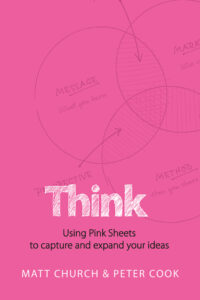
Someone’s attention is the currency, not my ideas. As a thought leader, I make a living by creating experiences. I’ll create an experience for an organization, and it’ll be a one-day event; I’ll take 50 people on a three-day retreat, and I’ll sit with an individual for two or three hours. These are all experiential things. I charge for experiences. What I deliver in those experiences are concepts. There are two things we need to cover off in these 20 minutes or so that we’ve got left. One of them is the architecture of an idea, and the second is how to deliver that idea into the world. Each one of them is an episode on its own. The pink book called Think is the book that people would want to download, which unpacks the Pink Sheet process.
I have a website called pinksheetprocess.com, where I’ve open-sourced (you could call it) the technology. The tool called a Pink Sheet is a technology that enables you to capture your thinking. The reason why this is important is that we haven’t really been taught to think. If I said to someone, “Go think, what would you do? Would you create a mind map, or would you create a bullet list?” These are all pathways into thinking, but they don’t feel robust enough.
What the Pink Sheet is, essentially on a piece of paper, five locations. But before I get to those five locations, if people could imagine, for those listening to the podcast, put a compass with north, south, east, and west on a piece of paper, organized portrait-style. The verticality, the backbone of an idea, is that they are at the bottom, at the south incredibly concrete, and at the north, they can be incredibly abstract.
If I said, “What is a croissant?” You would go, “It’s a pastry.” I go, “What is pastry?” You would go, “It’s food.” I go, “What is food?” You’d go, “It’s energy.” I go, “What is energy?” You’d go, “It’s life.” I go, “What is life?” You might go, “God.” So you’ve gone from croissant to God. That’s the verticality of an idea, but we’re talking about the same thing. You could do it with a Nashi pear, which is a fruit. What’s a fruit? It’s food.
We can interpret this vertebra, the vertical Y axis, the north-south dimension of an idea, as concrete and abstract. As thinkers, we tend towards either. We’re either meta and theoretical, or we’re matter and practical. I want to say that a full spectrum concept, when you think, captures your idea across that spectrum, the verticality from concrete to abstract.
We’ve already seeded a couple of these ideas in this podcast by example. If you go back and listen to this podcast again, on the other side of these final 15 minutes, you’ll actually be able to see the frameworks that I’m talking about being utilized. The horizontal, the east, and west axes of your compass are this idea of to the left, let’s put left-brain things, some analytical things, and to the right, let’s put right-brain things.
If you could see this compass now and push it into the background, watermark it on your paper, it’s no longer the piece of paper, but it’s a watermark that’s embedded into the paper. In grayscale, it’s light, and it floats underneath it. What we’re going to do now is layer on top of that vertically. We’re going to divide the portrait on this piece of paper you’re holding into thirds: a bottom third, a middle third, and a top third. Two lines are divided into the bottom, middle and top.
Let’s call the bottom third, content. Let’s call the top third context. Context is a word that can be used in the situation you’re in, my working context, my home context, but I want to use it around abstraction, the north part of the vertebra. When I say context, I mean abstract; I don’t mean the situation you find yourself in. The middle third, let’s call that concept.
If people wanted to access the epistemology of this idea, if you understand strategy versus tactics, you get it. If you understand the big picture versus the detail, you get it. I don’t claim that this is original in any way; it’s a synthesized process, which is why the tool is open source and free to the world.
You could call the top third the meta. When we talk about metacognition, that could be a way people access. You could call the bottom third the matter. What I encourage people to do now is in their mind’s eye or on a piece of paper, if what they’re doing is to put a figure eight around from top to bottom. It’s the infinity sign, but sitting up as an eight. I would say that context has a big bulge at the top of the meta. I say meta doesn’t take a lot of time, but it takes up a lot of space. Don’t think of a pink elephant as a metaphor, and you can’t not.
Meta fills minds, which takes up space.
Meta fills minds, which takes up space. The matter, the bottom third, imagine the figure eight coming down to the bottom third, that takes up a lot of time. To tell stories and to give people case studies, examples, facts, and to interpret data, all the content that is the croissant, the Nashi pear, all the stuff that is concrete and real, takes up a lot of time.
What a lot of thought leaders do is they live in the stuff, they live in the matter, or they live in the context, the big picture, the meta. To be a well-rounded thought leader, you need to access all three domains: the matter, the meaning and the meta. The Pink Sheet is a tool that, now, if you understand, you take the figure eight, and you go steep now back, you’ve got the north, south, east, west, you’ve got the figure eight, and you’ve got the third, the third, the third. All of them are ghosting now as watermarks.
We have five tools, specific tools, thinking tools, and when you capture your ideas, we suggest you are full spectrum and that you use all five, and they’re very, very simple. You should top left, use models. Put geometric shapes together, squares, triangles and circles and combine them in some way to frame the context. Use metaphors, which are the right-brain big picture, the right-brain meta tool. First, separate them into models and metaphors, and then integrate them. Your models have metaphors embedded or intrinsic in them.
Down the bottom third, you want to get numbers and narrative. What you want to do is have stories and case studies, statistics, and your personal journey stuff. When you add that narrative quality and the number quality, you separate them out first by going, here’s a case study, here’s some statistics, here’s some research, that would be bottom left of the Pink Sheet. You also might have a personal story, as you did about the interview, when one of your family members in Florida was dealing with a potential stroke, if I recall correctly.
If you’re listening to this on an audio podcast, you may want to download the Pink Sheet example. You may want to watch the videos that we’ve put on the Pink Sheet process and download the book to help you with this. Basically, you can take these frameworks and double-click on models and metaphors, numbers and narratives, and the middle one is mantras. Concepts are points you make, the statements you make, the propositions you put forward.
That’s the structure of a Pink Sheet. What often needs to happen is the theory that is great, and I’m teaching how to do it. One of the things that’s worth assessing is probably why, if you think only in application, when you write a white paper, the insights are buried in the input application. If you only create a speech, the insights are baked into the speech, and I can’t leverage them in any way. Insight mobility is about capturing what you know on a Pink Sheet, so that we can then deliver it in lots of different ways. You can deliver it in a book, a short video, or a social media post. You just have to know which bit of the Pink Sheet to use when, but the trick is to think delivery-agnostic.
Form your thinking without any attachment to how you’re going to share it. If you use the Pink Sheet process, you’ll have all the elements captured, so you can share them in all the different ways we do, which might be another podcast for another time. When we tell someone something, we use a different part of the Pink Sheet. When we show somebody something, we use a different part of the Pink Sheet. When we ask someone something to help them learn, we use a different part of the Pink Sheet.
The process is to think before you speak, and the Pink Sheet process is how we do that.
Whether it’s telling, showing, or asking, you’ll access different parts of the Pink Sheet, and it becomes almost a formula you can use: I’m running a three-day retreat using three Pink Sheets. How do I do that? You go, well, you use this bit in the first hour, this bit in the second hour, this bit in the third hour, and that’s how you plan a full-day experience. As opposed to writing a whole heap of stuff, putting on a slide deck and blasting it out to an audience, which is deeply disrespectful. Also, you haven’t thought enough. You’re speaking before you think. The process is to think before you speak, and the Pink Sheet process is how we do that.
This is phenomenal. I want to give a quick example from my life and my business of how I have applied your principles, so our listeners can understand how universally applicable and, in a practical sense, a daily, useful tool this Pink Sheet process is. One of my webinar presentations includes a slide. I happened to notice that I was going through it during a call today with a friend and a client. The slide content was just a few words—unconscious, motivators, and triggers. That’s it. That gave me a concept to talk to, but then I used a metaphor to really spice up the visual for that slide. The visual was an iceberg. The tip of the iceberg sticking out of the water is the conscious motivators, and, of course, the unconscious motivators are what’s under the surface, making up most of what we do.
We’re not connecting the dots so much that they can’t imagine or they’re not thinking. They’re seeing a pretty picture. If I were to have a concept of time as an illusion that I want to explain, and I had an optical illusion as the backdrop of that slide, that is too literal and boring, and there’s no room for people to try and connect the dots on their own. I love coming up with these metaphors and then finding the images—although I do hand off to my team the task of going on to stock photo sites to find them and stuff—I do really find these metaphors to be very powerful. People enjoy the presentation so much more than the versions I used to do before I understood what Pink Sheets were in the metaphors. I’d have bunches of words, lots of bullets, boring backgrounds, and no backgrounds. It was death by PowerPoint.
That’s such a great example, Stephan. Thank you for sharing it. For those who are hanging on by the fingertips of their attention because there are a million things going on for them, every one of those dimensions of the Pink Sheet is explained with a chapter each in the book. The chapter on metaphors talks about how deeply powerful they are. The chapter on models gives you some drop-down template examples of squares, triangles, and circles shoved together.
I don’t want people to think we’ve given them a loose scaffold and nothing else. The Pink Sheet process is to capture what you know profoundly changes your relationship with who you are and what you think you know. Be courageous as you go through this process because you’re on the wrong side of a whole lot of good work. As you start to document this knowledge warehouse, this filing cabinet full of Pink Sheets, you start to realize that there are filing cabinets, there are drawers, there are folders, that Pink Sheets nest and stack, and there’s so much in this.
When you catalog your intellectual property, because a Pink Sheet is just an IP snapshot, it’s just a thumbnail of an idea or an insight. When you begin to catalog them, you start to build a system of knowledge. That system of knowledge is highly valued, but if we’re in the wisdom economy right now, it’s not that we don’t have ideas; it’s that we can’t make them engaging, relevant, and meaningful. By thinking full-spectrum, you break your personal bias and become more considerate and compassionate toward the diversity of your audience.
Not only that, but our own diversity. There are topics that I want to be deeply concrete on, and there are topics I want to be beautifully abstract on. The ability to move, that’s what the north, south, east, and west do. It gives you a compass that gives you the ability to navigate any idea or concept at whatever level of detail or in whatever direction you want to go. That goes back to sovereignty and agency. Stephan, it’s beautiful to meet you. You’re so wonderful to be in a podcast with because I feel like you create a space, and we get to have a conversation in that space. I feel like I filled a lot of that space today. Thank you for being so gracious.
Thank you. This was so much fun. You are a powerhouse. You definitely are channeling something, too. You got a lot of wisdom that you shared with our listeners today, so thank you so much.
Thanks, Stephan. Pleasure.
Thank you. And thank you, listeners. Please, at least try your hand at doing a Pink Sheet or two and see where it takes you. We’ll catch you in the next episode. This is your host, Stephan Spencer, signing off.
Important Links
Connect with Matt Church
Books
People